
How eye-gaze technology helped our daughter find her voice
The device gave Cammy independence and joy
Written by |





Before our late daughter, Cammy, was diagnosed with Rett syndrome shortly before her second birthday, she was already receiving services through our state’s early intervention program. For 10 months — from 12 months old to 22 months old — her days were filled with appointments for physical therapy, occupational therapy, developmental therapy, feeding therapy, and speech therapy.
At the time, speech therapy focused on helping Cammy form sounds and words with her mouth. But as her second birthday approached and we learned more about what Rett syndrome would mean for her future, our focus shifted. Instead of teaching speech in the traditional sense, we began searching for a way for Cammy to communicate.
The process was both exhausting and fascinating. Before qualifying for a high-tech communication device, Cammy first had to try out several low-tech options to demonstrate that her hands weren’t reliable enough for direct use. With Rett syndrome, the loss of functional hand use is common. At just 10 months old, Cammy could feed herself with a perfect pincer grasp and flip through the pages of a book. Just a few months later, due to Rett syndrome regression, those abilities disappeared.

A transformational technology
Because Cammy could no longer reliably press buttons or navigate a tablet screen, an iPad-based communication system was not an option. Instead, we had to look at eye-gaze technology.
In 2011, the eye-gaze device felt revolutionary. It weighed over 6 pounds and looked more like a piece of medical equipment than a communication tool. Cammy first used the device at Easterseals. I asked my parents to come with us because I desperately wanted them to witness what I hoped would be Cammy’s first words — even if they came through a computerized voice.
Cammy sat in front of the screen grinning as the speech therapist pulled up a field of six choices and simply let her explore. Cammy fixed her eyes on one image for a few seconds and suddenly the device spoke: “Bubbles.”
The therapist immediately blew bubbles to show Cammy that her request had been understood. Cammy’s smile widened. Then she selected another box, and the device said, “Wow.” My mom and I both burst into tears.
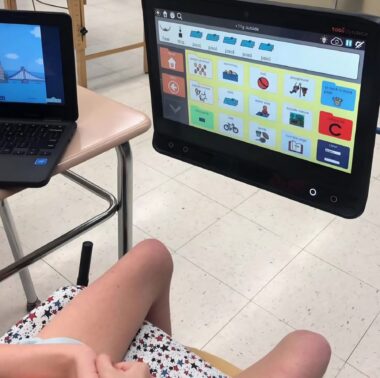
Photo courtesy of Jackie Babiarz
After receiving an eye-gaze system, Jacqueline Babiarz’s late daughter, Cammy, requested her family’s swimming pool during school in 2022. (Courtesy of Jacqueline Babiarz)
Cammy understood exactly what was happening. She knew she was controlling the computer. She knew that voice belonged to her.
At the time, the eye-gaze system cost around $18,000. We were incredibly fortunate that the evaluations, trials, and paperwork had all been completed before Cammy aged out of early intervention at age 3, allowing the state to cover the cost.
When the device finally arrived at our home in January 2012, one of the first things Cammy did was wish her dad a happy birthday. She was so proud of herself. After years of wondering what she wanted to say, what she understood, and what she wished she could express, we finally had a way to hear her. The words “I love you” and “happy birthday” were no longer trapped inside her.
The eye-gaze technology transformed life for our entire family. For the first time, Cammy could tell us when she wasn’t feeling well. We could open a page set with body parts, and she would accurately identify where it hurt — her throat when she had strep throat or her head when she had a fever.
The device also gave her independence and joy. She could paint, play instruments, roll dice, and participate in games on her own terms. She finally had control.
One of my favorite memories came after we installed an in-ground pool. Her teachers sent me photos of her communication screen at school where she repeatedly selected the word “pool” over and over again: “Pool. Pool. Pool.”
We were not guessing what Cammy was thinking. We were hearing her voice.
Note: Rett Syndrome News is strictly a news and information website about the disease. It does not provide medical advice, diagnosis, or treatment. This content is not intended to be a substitute for professional medical advice, diagnosis, or treatment. Always seek the advice of your physician or other qualified health provider with any questions you may have regarding a medical condition. Never disregard professional medical advice or delay in seeking it because of something you have read on this website. The opinions expressed in this column are not those of Rett Syndrome News or its parent company, Bionews, and are intended to spark discussion about issues pertaining to Rett syndrome.


Leave a comment
Fill in the required fields to post. Your email address will not be published.