
On the trail of pot, and help for my daughter with Rett syndrome
Half a century ago, I chased a story that's now relevant to my kid's disability
Written by |





In early autumn 47 years ago, I was lying in the back seat of a beat-up car with a sheet over my head as a couple of guys drove me deep into the sparsely inhabited scrubland of western Maine. I was on my way to take some scandalous photographs, ones that I thought might put me in jail.
I was just two years out of college and a reporter for The Central Maine Morning Sentinel, covering Franklin County, Maine. I was writing a two-part series about the case of Tom Bassford, a county man who kept bumping up against the legal system because he liked to grow and use marijuana, which was an illegal drug at the time. The police had recently pulled up about 400 of Bassford’s pot plants, and, as I wrote back then, he was mad as hell.
Bassford was arguing, in the articles I wrote and in court, that the seizure of his plants was a violation of his rights and that people should be allowed to grow pot for personal use. He and others I quoted contended that it was futile for the police to try to hunt down every private plant in a sparsely populated state, and to prove the point, I was being driven to a marijuana field to take pictures of some plants the cops hadn’t found, photographs that were used to illustrate my article.

There was a sheet over my head because the guys driving me didn’t want me to be able to tell anyone where the field was. I was especially worried about one person who might ask: Judge John Benoit, the local magistrate, who was sometimes called “Hangin’ John” because of his harsh sentences. I feared that Benoit would haul me into court and demand to know who brought me to the field of illegal wacky weed, and that he’d throw me in jail when I refused to name my sources. Thankfully, the court summons I was expecting never came.
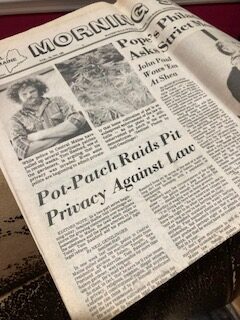
The front page of The Central Maine Morning Sentinel, Oct. 4, 1979. (Photo by Neil Genzlinger)
I mention all of this because a few hours ago, I gave my daughter Abby, who has Rett syndrome, an eyedropper full of CBD + CBG extract, which is, of course, derived from the cannabis plant. I didn’t even have to put a sheet over my head to get it; I bought it legally from a mail-order outfit in Vermont.
We’ve been trying the extract on Abby at the suggestion of one of my brothers, whose wife had used it successfully to ease her anxiety while she was dying of cancer. As I’ve written previously, Abby has been doing a lot of unexplained screaming and sobbing for months now, and we wonder if the culprit is anxiety, something that a lot of people with Rett syndrome in Abby’s age bracket seem to experience.
The extract, which doesn’t contain the trippy parts of marijuana, tastes awful, so when we squirt it into Abby’s mouth we chase it with some Nerds Gummy Clusters, an intensely flavorful candy that seems designed to make you forget whatever else you’ve ingested recently. In any case, she doesn’t generally object to the stuff, and we think it may be helping, though the experiment is ongoing. On social media, other Rett syndrome parents also talk about trying CBD and other cannabis-related products on their kids.
Bassford and law enforcement kept butting heads long after I’d moved on from The Sentinel, and I lost track of his legal battles. But one thing that struck me as I reread those 47-year-old articles was another argument that Bassford and others were making at the time: that the energy being put into criminalizing marijuana might better be put toward studying the possible beneficial uses of pot and its extracts. I’d say they were right about that.
Note: Rett Syndrome News is strictly a news and information website about the disease. It does not provide medical advice, diagnosis, or treatment. This content is not intended to be a substitute for professional medical advice, diagnosis, or treatment. Always seek the advice of your physician or other qualified health provider with any questions you may have regarding a medical condition. Never disregard professional medical advice or delay in seeking it because of something you have read on this website. The opinions expressed in this column are not those of Rett Syndrome News or its parent company, Bionews, and are intended to spark discussion about issues pertaining to Rett syndrome.


Leave a comment
Fill in the required fields to post. Your email address will not be published.