
My daughter with Rett syndrome made history and has a T-shirt to prove it
This ambitious study was a game-changer for a little-known disability
Written by |





Welcome to another installment of the T-shirt chronicles, an occasional series in which I relate tales of our family’s Rett syndrome journey as told by my daughter Abby’s bureau-busting collection of T-shirts.
Some of my least favorite among Abby’s shirts are heavy on words but light on real meaning. “We do not need magic to transform our world,” one says, quoting a commencement address given by J.K. Rowling, author of the Harry Potter books. “We carry all the power we need inside ourselves already.” It’s a harmless enough feel-good sentiment that, like most such sentiments, probably isn’t true, and in any case it’s a lot to hang on a shirt.
“I have Rett syndrome,” another shirt says. “I am sweet, fierce, unique, clever, innocent, angelic, driven, determined, strong, patient, beautiful, amazing, funny, pure, unstoppable, spunky, inspirational, smart, persistent, feisty, opinionated, joyful, unstoppable, brave, fighter.” Again, a bit too feel-goody for my taste. Also, why the lone noun among all those adjectives? Also, anyone who’s staring at my daughter’s chest long enough to read all that is likely to get a punch in the nose from me, and possibly from Abby.

I prefer a shirt she has that is somewhat less verbose and celebrates an actual accomplishment rather than spouting airy bromides. “I made a difference,” it says. “I made history! Rett syndrome natural history study.”
It was given to Abby, who is 29, maybe 15 years ago — my wife, Donna, and I can’t remember exactly — at one of the check-in sessions for the Rett syndrome natural history study, in which Abby participated for years. For her, participating in the study simply meant existing and allowing herself to be dragged to an appointment once a year or so to be measured, weighed, poked, and prodded while we, her parents, filled out questionnaires about her skills, her health, and so on.
Hundreds of people with Rett syndrome were signed up for the study, which began enrolling participants in 2006 and ran for 15 years. I don’t know if all those other participants got T-shirts, but I do know that they, as Abby’s shirt says, “made history,” in a very literal sense.
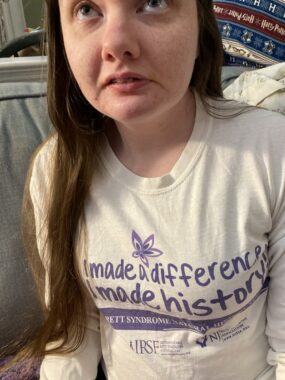
Abby Genzlinger in her T-shirt commemorating the groundbreaking natural history study on Rett syndrome. (Photo by Neil Genzlinger)
A quarter-century ago, all of us in Rettland — doctors, researchers, parents — were still in the relatively early stages of figuring out what Rett syndrome is and how it progresses. Other disabilities and diseases had been known and studied for decades, sometimes centuries, but Rett syndrome was still, in many senses, a disease without a history. By tracking a large cohort of individuals over a significant stretch of years, the natural history study built a credible database of information about the different types of Rett syndrome, how the condition manifests itself, what skills those who have it are likely to lose and when, their expected longevity, and much more.
As for the “I made a difference” part of Abby’s shirt, the study is said to have been the basis for at least 60 research papers. And it gave biotech companies a starting point to build clinical trials for the genetic and other treatments now being actively tested.
“Without it,” Dominique Pichard, chief scientific and medical officer at the International Rett Syndrome Foundation, said in March in a webinar on the state of research, “we wouldn’t be advancing therapeutics the same way.”
The natural history study, which was funded primarily by the National Institutes of Health, ended in 2021. I don’t think Donna and I grasped how important it would be while it was under way, but we get it now. Abby has recently enrolled in a successor study, the Rett Syndrome Registry, which will continue to expand the knowledge base.
Designing and implementing the natural history study a quarter-century ago must have been a titanic undertaking. I’m writing this two days before Thanksgiving to say thanks to the doctors and researchers and Rett syndrome advocates who got that ball rolling. Like Abby, they made history, and made a difference.
Note: Rett Syndrome News is strictly a news and information website about the disease. It does not provide medical advice, diagnosis, or treatment. This content is not intended to be a substitute for professional medical advice, diagnosis, or treatment. Always seek the advice of your physician or other qualified health provider with any questions you may have regarding a medical condition. Never disregard professional medical advice or delay in seeking it because of something you have read on this website. The opinions expressed in this column are not those of Rett Syndrome News or its parent company, Bionews, and are intended to spark discussion about issues pertaining to Rett syndrome.

Leave a comment
Fill in the required fields to post. Your email address will not be published.